How I Built My Own Grammarly With Replit
Introduction
Every year, right on schedule, Grammarly sends me the same email: your subscription is renewing, $144 will be charged. Every year I paid it without thinking — until this year, when I stopped and asked what I was actually paying for.
Not much, it turns out. A grammar checker with a fixed feature set that knows nothing about my workflow — my tools, my process, how I write and publish. I was renting a tool that would never quite fit.
So instead of renewing, I built my own.
Build vs.buy
Here's the thing about subscription tools: you're paying to live inside someone else's roadmap. If Grammarly doesn't build the feature you want, you don't get it — no matter what you're paying. Building your own flips that. It costs more time upfront, but every feature is one you chose.
With AI-assisted coding tools moving as fast as they are, that upfront cost isn't what it used to be. So I figured: why not test it?
Turning $144 into an app
I took the $144 I would've spent on Grammarly and put it into Replit credits instead. Same money, completely different outcome — instead of a renewal receipt, I had a budget to build something.
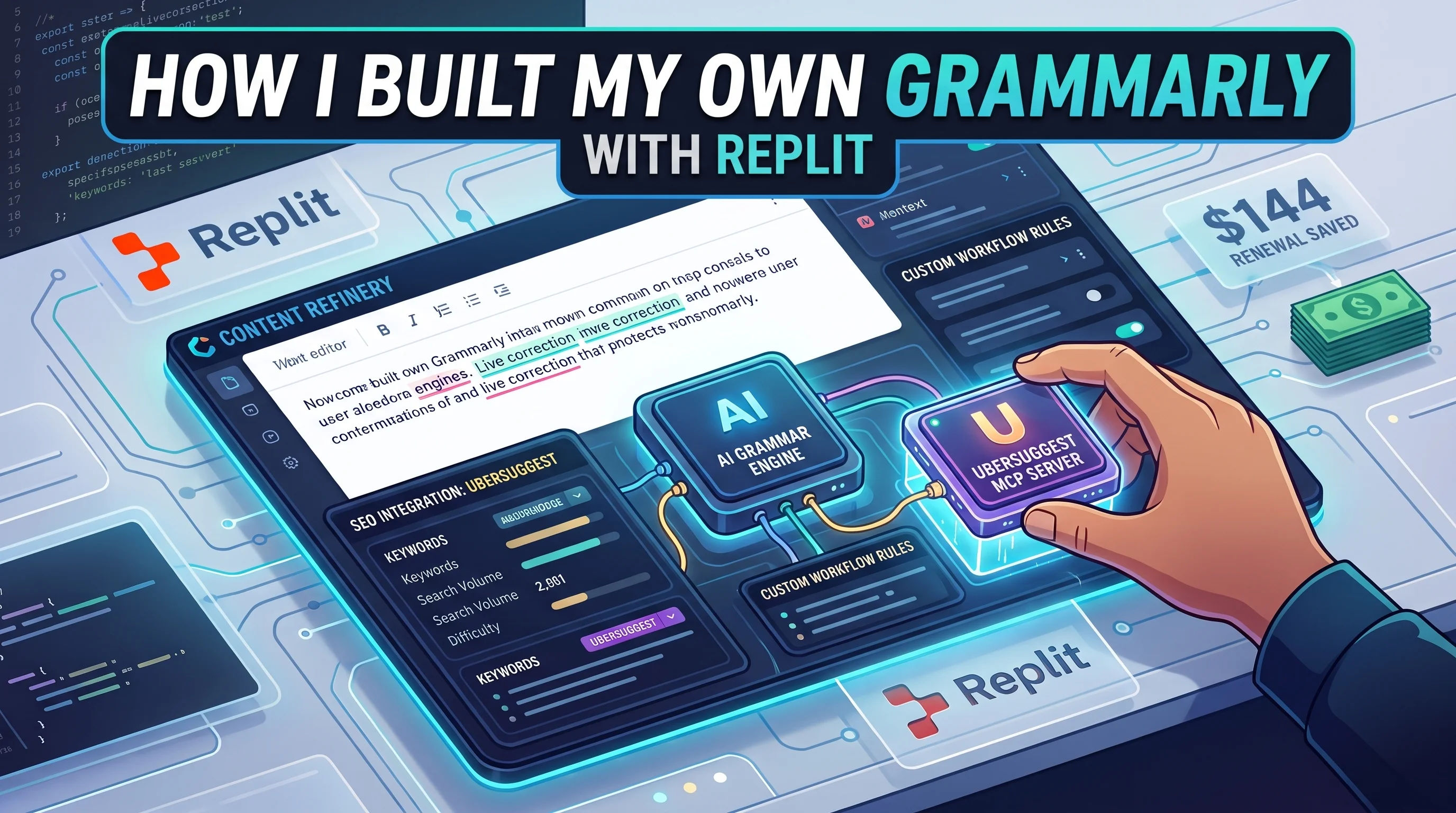
Within a day, I had a working first version. It's called Content Refinery. It does the core job Grammarly did — catching what a spell-checker misses, tightening my writing — but built around how I actually work.
A day of AI-assisted building won't give you a polished product. But "polished" wasn't the goal. "Fits my workflow" was, and that part worked.
The feature that made it worth it
The best part of Content Refinery isn't the grammar checking. It's the SEO integration with Ubersuggest, the keyword research tool I've used for years — always in a separate tab, a separate step, disconnected from the actual writing.
Ubersuggest offers an MCP server. Replit has MCP integrations built in. Hooking the two together took seconds — not a figure of speech, actual seconds. Now keyword research lives inside my editing workflow, where it always should have been.
That's the feature I couldn't ask Grammarly for, because it was never going to build it. It exists only because I built the tool myself.
Was it worth it?
I didn't just save $144. I ended up with a tool that fits my process better than the one I was paying for — plus a keyword-research integration I'd wanted for years and never had a way to get.
If you renew a subscription on autopilot every year, it's worth asking: what would it look like to turn that budget into something of your own?
Content Refinery is still evolving, more on what's next soon.
What does it cost me per month to keep running this thing after the credits run out?
There isn’t a fixed monthly subscription for Content Refinery at the moment. The ongoing cost depends on how often I use it, how long the drafts are, and how many AI editing passes I run. The main usage comes from the AI requests and the Ubersuggest keyword searches.
For my own use, I’m not running it constantly or serving a large number of users, so the cost should be much lower than a $144 annual Grammarly subscription. But I wouldn’t claim a precise monthly figure until I’ve used it for a full month and checked the actual usage.
How did I actually build it?
I started by describing the tool I wanted in ordinary language: an editor that could improve grammar, remove unnecessary wording, work with keywords, show me what had changed, and let me accept or reject those changes.
Replit generated much of the initial application from those descriptions. It created the editor, the buttons, the database connection, the AI editing workflow, and the keyword-research screens. I then used the app, found the places where it behaved incorrectly, and asked Replit to fix and improve them.
The process was less like writing every line of code myself and more like working with a very fast technical partner. I described the result I wanted, tested it, reported what was wrong, and refined it step by step.
Do I need to know how to code?
You do not need to be a professional programmer to build something like this with Replit. I was able to describe features in plain English and have Replit create a working version.
But “no-code” would be an oversimplification. You still need to explain what you want clearly, test the result, notice when something is wrong, and make decisions about how the product should behave. Some technical knowledge becomes helpful when you are connecting services, fixing unexpected behaviour, or making the app more reliable.
The biggest requirement is not knowing every programming language. It is being willing to think like a product owner: explain the problem, try the result, and keep improving it.
How do you connect Ubersuggest? Are there configuration steps?
The connection is simpler than I expected. Inside Content Refinery, I click the button to connect Ubersuggest. Replit sends me through the normal authorisation process, I sign in and approve the connection, and then the app can request keyword information when I ask for it.
I did not have to copy API keys into the application or manually configure a complicated integration. Once the connection is authorised, I can search for a keyword from inside the editor and see information such as search volume, difficulty, cost per click, and search intent.
Can anyone use Content Refinery, or is it private?
At the moment, Content Refinery is primarily a tool I built for myself, rather than a finished public product with user accounts, pricing, and customer support.
I can share the app when appropriate, but it is not yet positioned as a public Grammarly replacement that anyone can sign up for. I would need to make a few more decisions around user accounts, privacy, separate users’ drafts, usage limits, and each person connecting their own Ubersuggest account before opening it up properly.
For now, the honest description is: it is my personal writing and content-production tool, built in a way that could eventually become something other people use.